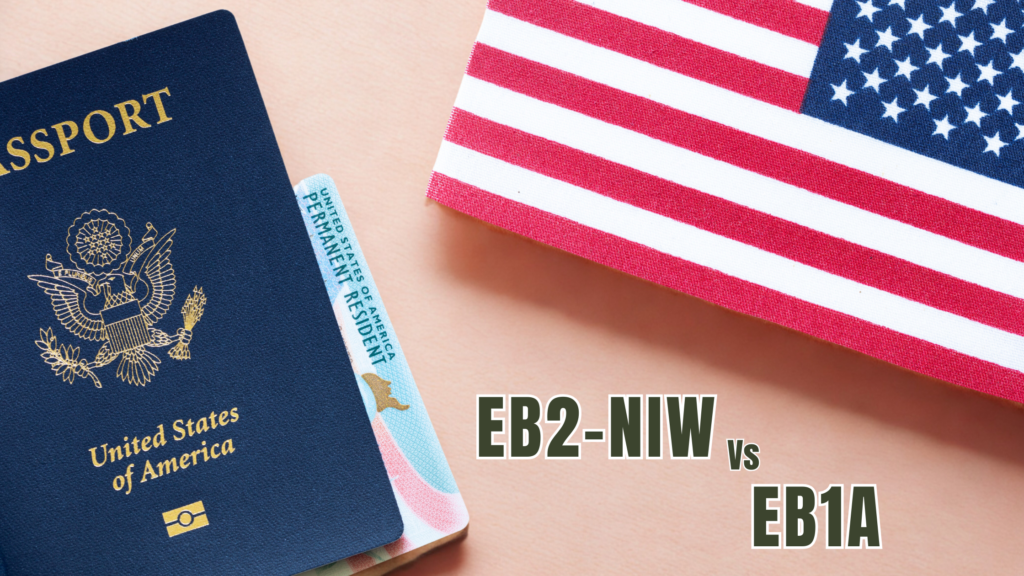
For founders, researchers, and highly skilled professionals, two employment-based green card options come up again and again:
- EB-2 National Interest Waiver (NIW)
- EB-1A Extraordinary Ability
Both allow applicants to self-petition, with no permanent job offer or labor certification required. But they are not interchangeable, and choosing the wrong path can lead to wasted time, unnecessary RFEs, or denial.
Here’s how to think about NIW vs. EB-1A strategically.
The Big Picture Difference
At a high level:
- NIW asks: Is your work important enough to the United States to waive the job offer requirement?
- EB-1A asks: Are you among the small percentage at the very top of your field?
Both focus on merit — but they measure it very differently.
What Is the National Interest Waiver (NIW)?
The NIW is part of the EB-2 category and is often a strong option for:
- Startup founders
- Applied researchers
- Engineers
- Entrepreneurs working on emerging or socially valuable technologies
USCIS applies a three-part test (from Matter of Dhanasar) to evaluate NIW petitions.
NIW focuses on:
- The importance of your work (national interest)
- Your ability to advance that work
- Whether waiving a job offer benefits the U.S.
NIW does not require you to prove you are at the very top of your field, only that your work has substantial merit and national importance.
What Is EB-1A Extraordinary Ability?
EB-1A is reserved for individuals who can demonstrate sustained national or international acclaim.
It’s commonly pursued by:
- Leading researchers
- Well-published academics
- Highly visible founders
- Industry leaders with documented impact
USCIS evaluates EB-1A petitions using a two-step framework:
- Meeting at least 3 of 10 regulatory criteria
- A qualitative assessment of overall acclaim
While EB-1A offers faster visa availability, it also carries higher evidentiary risk.
NIW vs. EB-1A: Side-by-Side Comparison
| Factor | NIW | EB-1A |
| Standard | National interest | Extraordinary ability |
| Top of field required? | ❌ No | ✅ Yes |
| Job offer required | ❌ No | ❌ No |
| Evidence focus | Future impact | Past & sustained acclaim |
| Typical RFEs | National importance, benefit | Final merits, acclaim |
| Visa availability | May be backlogged | Often current |
Which Is Better for Founders?
For early-stage founders, NIW is often the better first option because:
- Impact may be emerging, not yet fully realized
- Companies may still be pre-revenue or early traction
- Recognition often comes after execution
EB-1A can make sense later, when:
- The company has measurable national or international impact
- The founder has press, awards, speaking roles, or major funding
- Leadership is clearly distinguished from peers
Many founders pursue NIW first and EB-1A later as their profile grows.
Which Is Better for Researchers?
For researchers:
- NIW works well for applied, interdisciplinary, or industry-focused research
- EB-1A is strongest for researchers with:
- High citation counts
- Independent peer review activity
- Leading authorship
- Recognized influence in the field
Neither path is “easier” — they simply reward different kinds of evidence.
Common Strategic Mistakes
- Filing EB-1A too early “just to try”
- Underselling impact in an NIW petition
- Treating either category as a checklist exercise
- Ignoring how USCIS evaluates credibility and trajectory
- Failing to plan for RFEs or timing issues
Strategy matters more than category.
Unsure whether NIW or EB-1A fits your background?
Choosing the right category can save months, or years, and significantly reduce risk. visa iQ works with founders, researchers, and technical professionals to evaluate credentials honestly and build a strategy that aligns with both short- and long-term goals.
👉 Book a consultation with visa iQ to assess whether NIW, EB-1A, or a staged approach makes the most sense for you.